

Table of Contents
- What Makes a Customizable Landscape Canvas Worth the Investment
- Canvas Print Size Guide: Finding the Right Dimensions
- How to Prepare Photos for Canvas Printing
- Customizable Landscape Canvas Options: Framed vs. Unframed
- Materials, Durability, and Print Quality
- Interior Design Styling: Integrating Landscape Canvas Into Your Space
- Canvas Maintenance and Longevity
- Conclusion
Last Updated: August 12, 2026
What Makes a Customizable Landscape Canvas Worth the Investment
A customizable landscape canvas transforms your living space in ways generic wall art cannot. At paints2prints, we've worked with homeowners across the U.K. and E.U. who discovered that personalised landscape prints deliver the exact mood, scale, and aesthetic their room needed. The real investment is choosing materials, printing techniques, and customisation options that guarantee your canvas remains vibrant for years. The difference between archival-quality inks and budget alternatives can mean the difference between a print that holds its colour for decades and one that visibly fades within two years.
This guide covers sizing your space correctly, preparing your photos for beautiful printing, understanding the materials that matter most, and styling your finished canvas as a true focal point.
Canvas Print Size Guide: Finding the Right Dimensions
Getting the size right is non-negotiable. Too small and your canvas disappears into the wall. Too large and it dominates awkwardly. The right size depends on your wall space, viewing distance, and the room's purpose.
Small canvases (20-40cm)
Small landscape canvases work best as accent pieces or in compact spaces. A 20cm × 30cm print suits narrow hallways, bedrooms, or shelving displays. These sizes are ideal if you're renting and want flexibility. The trade-off is impact, small canvases require viewers to move closer to appreciate detail, so they work best in rooms where people spend time stationary: beside a reading chair, above a desk, or in an entryway.
Medium canvases (40-60cm)
Medium landscape canvases hit the sweet spot for most living spaces. A 40cm × 60cm or 50cm × 75cm print works beautifully above a sofa, on a feature wall, or as part of a gallery arrangement. At this size, your canvas becomes noticeable without requiring a massive wall. Medium-sized prints balance cost with impact, providing substantial visual return without the expense of oversized wall art.
Large landscape wall art for living rooms (60cm and above)
Large landscape canvases (60cm, 80cm, or 120cm+) transform a room. A 60cm × 90cm print becomes your wall's main event. Large prints demand planning, your wall must have the space, and your furniture must support the visual weight. A 120cm-wide panoramic landscape canvas above a sofa is striking; the same canvas in a small bedroom would feel claustrophobic. The advantage is presence: your canvas becomes the first thing people notice when they enter.
How to Prepare Photos for Canvas Printing
Your photo's quality determines your print's quality. A stunning landscape image on your phone might look disappointing printed at 80cm wide if the resolution is too low.
Resolution and image quality requirements
Canvas printing requires high-resolution images. The industry standard is 300 dots per inch (DPI) at your final print size. A photo from a modern smartphone typically has sufficient resolution for prints up to about 40cm × 60cm. Beyond that, you'll need either a higher-resolution camera or a larger original file. Check your image file size before uploading; a file that's only a few megabytes might not have enough pixel information for a large print.
Brightness and contrast matter too. Photos taken in poor lighting often look flat when printed. Edit your image first, adjust exposure, increase contrast slightly, and ensure colours are vibrant. Basic adjustments in your phone's photo app can make a significant difference.
Aspect ratio and cropping for landscape orientation
Aspect ratio is the relationship between your image's width and height. Common canvas aspect ratios are 3:2, 4:3, and 16:9. If your photo doesn't match your chosen canvas ratio, you'll need to crop it. Preview how your image will look cropped to your canvas size using your printing service's digital preview tool. Adjust the crop until the composition feels balanced and all essential elements are visible.
Customizable Landscape Canvas Options: Framed vs. Unframed
Your choice between framed and unframed affects both appearance and installation.
Unframed canvas prints
An unframed canvas is stretched directly over wooden bars (stretcher bars) and arrives ready to hang. This creates a clean, modern look that works beautifully in contemporary or minimalist spaces. Unframed canvases are typically less expensive and installation is straightforward. The trade-off is durability at the edges, over time, the exposed canvas wrap can show wear, particularly in humid environments. Unframed works best in rooms where the canvas will be your focal point and won't be at risk of contact.
Framed canvas prints and gallery wrap finishes
A framed canvas print adds a border around your image, typically in wood or metal, creating a more finished, gallery-like appearance and offering practical protection. Gallery wrap is a middle ground, the canvas stretches around the wooden bars with the image continuing slightly onto those wrapped edges, creating depth and a sophisticated appearance. Framed options offer advantages beyond aesthetics: the frame protects your investment and the finished appearance is immediately professional. In formal living rooms or spaces with traditional furnishings, framed canvases often feel more at home than unframed.
| Option | Best For | Advantages | Considerations |
|---|---|---|---|
| Unframed Canvas | Modern, minimalist spaces | Lower cost, clean aesthetic, easy installation | Exposed edges, less protection |
| Gallery Wrap | Contemporary or eclectic rooms | Sophisticated look, wrapped edges, good balance | Moderate cost increase |
| Framed Canvas | Traditional or formal spaces | Maximum protection, finished appearance, visual weight | Higher cost, more permanent |
Materials, Durability, and Print Quality
What your canvas is made of and how it's printed directly affects longevity and vibrancy.
Canvas fabric and frame construction
Premium canvas uses 100% cotton or high-quality poly-cotton blends that resist fading and maintain texture over time. The weight of the canvas (measured in GSM, grams per square metre) matters, a 260-280 GSM canvas feels substantial and durable. Wooden stretcher bars should be kiln-dried pine or similar hardwood, not soft wood that warps as it dries. The thickness of the bars (typically 18mm or 38mm) affects how the canvas hangs and the depth of your finished print. Check whether your canvas is hand-stapled or machine-stapled on the back; hand-stapling creates a tighter, more even stretch.
Ink types and fade resistance
Archival pigment inks are the gold standard. They're formulated to resist UV exposure and humidity, maintaining colour vibrancy for decades. Budget services sometimes use dye-based inks, which fade noticeably within 2-5 years, particularly in rooms with direct sunlight. UV-resistant inks are essential if your canvas will hang in a room with windows or skylights. Pigment-based archival inks typically maintain 90%+ of their original colour for 20+ years, even with moderate sunlight exposure.
Professional giclee printing (a fine-art printing technique) produces superior colour accuracy and detail compared to standard commercial printing. It's more expensive but worth it for landscape canvases where subtle colour gradations matter. paints2prints uses archival-quality inks designed to resist fading, ensuring your customizable landscape canvas remains vibrant for years.
Interior Design Styling: Integrating Landscape Canvas Into Your Space
Your canvas's impact depends on how you style around it.
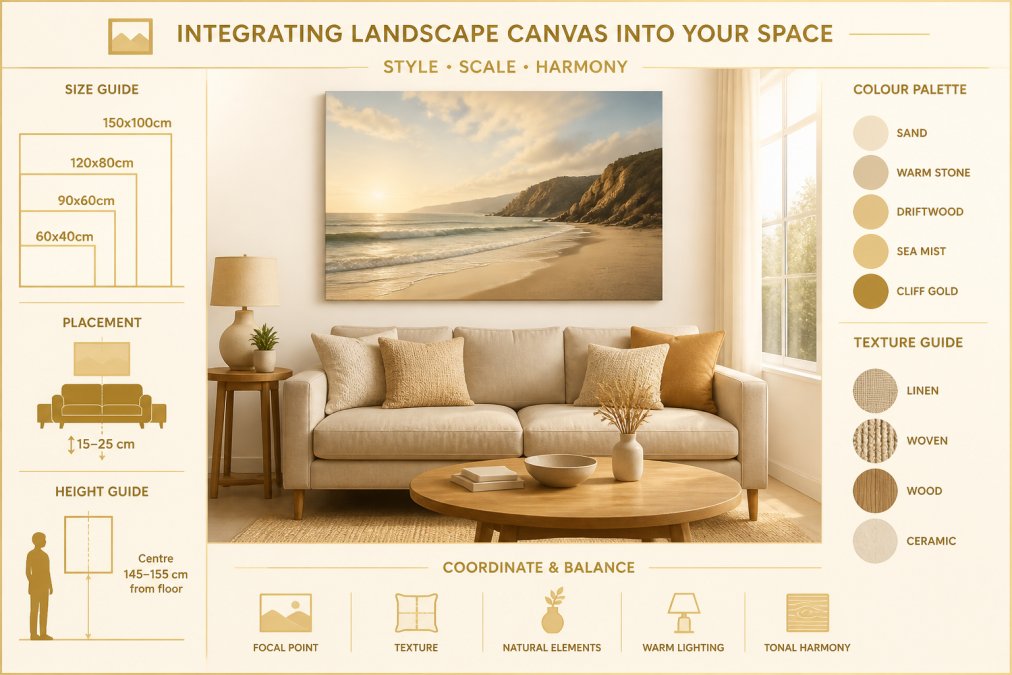
Treat your canvas as your room's anchor. Choose your colour palette based on the landscape image. If your canvas features cool blues and greens, pull those tones into your furnishings, cushions, or throws. This creates visual harmony rather than the canvas feeling isolated.
Lighting dramatically affects how your canvas looks throughout the day. Natural light is ideal, but ensure direct sunlight doesn't create glare. In rooms without natural light, consider a picture light above the canvas. Wall colour matters too, a white or neutral wall makes your canvas pop. Coloured walls can work, but they compete with your canvas.
For landscape canvases in living rooms, position your canvas at eye level when seated, approximately 1.5 metres from the floor. If hanging above a sofa, ensure there's 20-30cm of space between the sofa back and the bottom of the canvas. Gallery walls work beautifully with landscape canvases, pair your large print with smaller pieces in a curated arrangement, keeping spacing consistent (typically 5-7cm between pieces).
Canvas Maintenance and Longevity
Your canvas will last for decades with proper care.
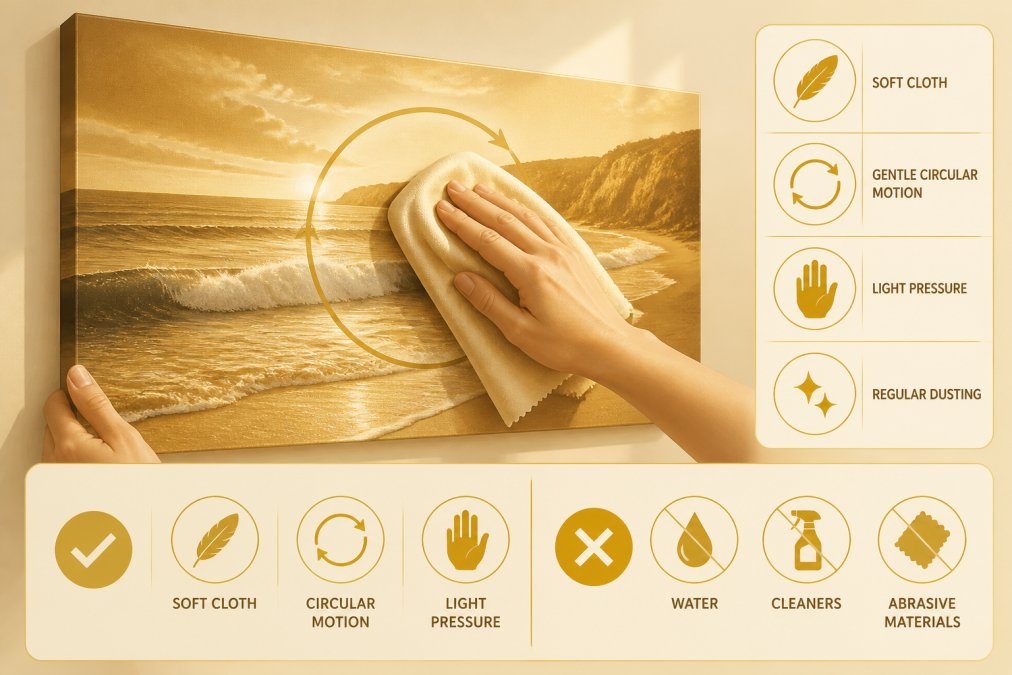
Dust your canvas every 3-6 months using a soft, dry, lint-free cloth. Avoid paper towels or rough fabrics. Never use water, cleaning solutions, or compressed air. Keep your canvas away from direct sunlight, while archival inks resist fading, prolonged UV exposure will eventually shift colours. Sheer curtains or adjustable blinds help control light exposure.
Humidity affects canvas longevity. Most homes naturally fall within a comfortable range, but ensure good air circulation around your canvas. Avoid hanging your canvas directly above heat sources (radiators, fireplaces, heating vents), as heat causes expansion and contraction that can warp the stretcher bars. Similarly, avoid cold exterior walls in winter.
If your canvas gets knocked or bumped, inspect it for damage. Minor creases usually disappear within days. Punctures or tears are more serious and typically require professional repair or replacement.
Choosing the right customizable landscape canvas means balancing quality materials, proper sizing, and thoughtful styling. paints2prints simplifies this by offering handcrafted landscape prints with options for framed or unframed finishes and customizable sizes, all backed by free shipping to the U.K. and E.U. Start by measuring your space, preparing your image using the resolution and aspect ratio guidelines above, and envisioning how your finished canvas will anchor your room's design. The investment in a high-quality print pays dividends in durability and visual impact for years to come.
Frequently Asked Questions
What resolution do I need for a high-quality landscape canvas print?
For sharp, professional results on a customizable landscape canvas, aim for a minimum of 150 DPI (dots per inch) at your final print size. A 300 DPI image guarantees exceptional clarity, especially for large prints. If you're enlarging a photo, ensure your original file is at least 1200 x 800 pixels. Many providers offer a free photo check service to assess your image quality before printing, so use this to confirm your file will produce vibrant, crisp results.
How do I choose the right canvas print size guide for my living room?
Measure your wall space and aim for the canvas to occupy 50-75% of the wall area. For a living room accent wall, a canvas 60cm or larger creates visual impact. Consider your viewing distance: from 2-3 metres away, a 60-80cm landscape canvas is ideal. Leave 15-20cm of space around the canvas for balance. If you're unsure, sketch the dimensions on your wall with painter's tape first, or order a digital preview to visualise the final look.
Will my customizable landscape canvas fade or lose colour over time?
High-quality landscape canvases use UV-resistant, archival inks and fade-resistant polyester or cotton canvas, designed to preserve colours for decades. Avoid direct sunlight exposure, which accelerates fading, position your canvas on walls away from windows or use UV-protective glass if needed. Keep humidity levels stable and dust the surface regularly with a soft, dry cloth. Many providers offer lifetime guarantees on their prints, giving you confidence in durability and colour longevity.
Can I use my own photography for a customizable landscape canvas?
Yes, most providers allow you to upload your own landscape photos. Ensure your image meets their resolution requirements (typically 150 DPI minimum) and is in a landscape orientation. Use their online editor to preview how your photo will look, adjust colours if needed, and confirm the aspect ratio matches your chosen canvas size. Some services offer a digital proof for approval before printing, so you can verify colours and composition match your expectations.
What's the difference between framed and unframed canvas prints for home decor?
Unframed canvases feature a gallery wrap finish with the image wrapped around the sides of a wooden frame, creating a modern, seamless look without needing additional framing. Framed canvases include a decorative border, adding a traditional or formal aesthetic. Unframed options are easier to hang and suit contemporary interiors; framed options work well in classic or eclectic spaces. Unframed prints typically cost less, while framed options offer a finished, polished appearance straight from the box.
This article was written using GrandRanker
0 comments