

Table of Contents
- What Makes High Quality Canvas Art Stand Out
- Material Quality and Canvas Composition
- Understanding Print Resolution and Ink Quality
- Custom Canvas Prints: What You Need to Know
- Canvas Print Quality Checklist: What to Inspect Before Buying
- How to Choose Canvas Art Size for Your Space
- Gallery Wrap Versus Framed Canvas: Which is Right for You
- Price, Value, and What You're Actually Paying For
Last Updated: August 18, 2026
What Makes High Quality Canvas Art Stand Out
The best canvas prints share three hallmarks: materials that resist fading, printing techniques that capture fine detail, and construction that keeps the canvas taut and wrinkle-free for years. The UK online art market generated USD 724.7 million in 2024 and is projected to reach USD 1.32 billion by 2033, growing at 6.9% annually. But not all canvas art is created equal. The difference between a £30 print and a £69 piece from paints2prints isn't just price, it's the engineering underneath: canvas weight, ink formulation, stretcher bar construction, and finishing all determine whether your art will look fresh in five years or faded in eighteen months.
Material Quality and Canvas Composition
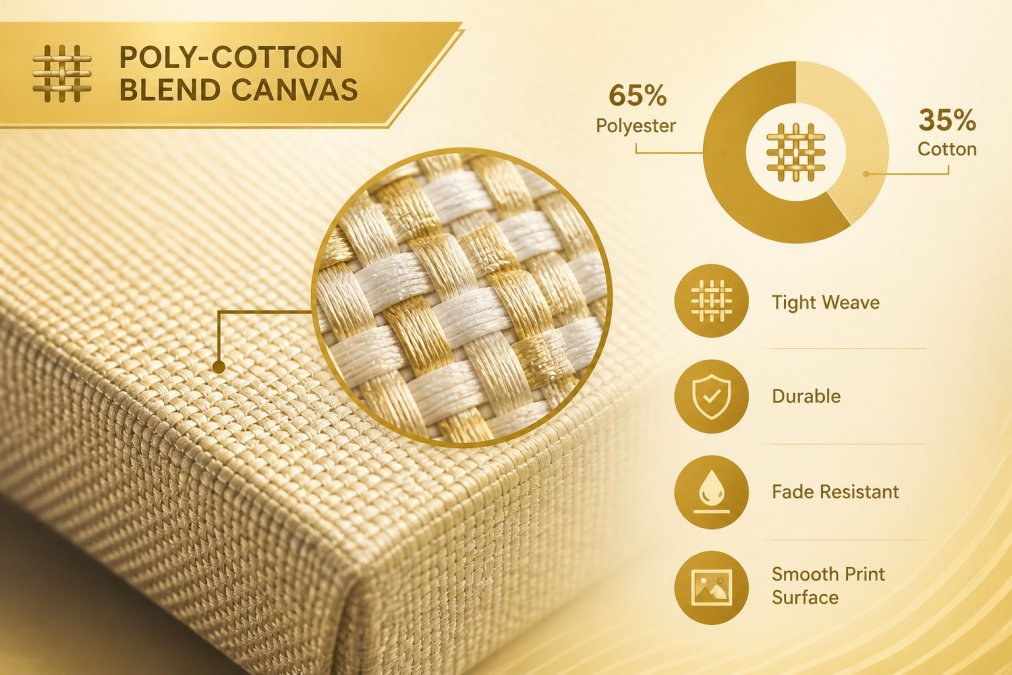
Canvas comes in two primary blends: 100% cotton and poly-cotton combinations. Pure cotton is naturally archival and produces richer colour saturation, but it's expensive and prone to stretching under humidity changes. Poly-cotton blends (typically 65% polyester, 35% cotton) offer a practical middle ground, polyester provides dimensional stability so your canvas won't expand and contract with seasonal humidity, while cotton preserves the natural feel and ink absorption. This balance is what paints2prints uses across their coastal and landscape prints.
Canvas weight and durability
Canvas weight, measured in GSM, directly correlates with longevity. Standard canvas runs 280-320 GSM; premium canvas sits at 350-400 GSM. Lighter canvas can develop wrinkles or sag within a few years, especially in larger formats. When evaluating high quality canvas art, ask the retailer for the GSM specification. Reputable sellers publish these details because they're selling confidence.
Understanding Print Resolution and Ink Quality
DPI and image clarity
DPI (dots per inch) determines how crisp your print looks. Professional print houses use 300 DPI as the baseline for photographic quality. Anything below 200 DPI risks visible pixelation, especially on large prints. For landscape and coastal photography, 300+ DPI is non-negotiable because these images rely on fine detail: wave texture, cloud gradation, sand grain definition.
When buying custom canvas prints online, check what resolution the retailer will print at. A 300 DPI print of a coastal scene reveals individual foam crests on breaking waves; a 150 DPI version looks soft and blurry. If uploading your own image, ensure it's at least 300 DPI at your intended print size.
UV-resistant inks and fade resistance
Professional-grade inks contain UV inhibitors that prevent colour shift under sunlight exposure. Budget inks lack these additives, and colours degrade within 18-24 months in bright rooms. Ask whether the printer uses pigment-based or dye-based inks. Pigment-based inks (more expensive) resist fading and are archival-rated for 100+ years. Dye-based inks (cheaper) fade noticeably within 5-10 years.
Custom Canvas Prints: What You Need to Know
Digital file requirements and colour accuracy
Colour accuracy is where custom prints often disappoint. Your monitor displays colours in RGB (red, green, blue light), but canvas prints use CMYK inks (cyan, magenta, yellow, black). Quality printers will provide colour profiles or a soft-proof service showing how your image will actually print. Ensure your file is in CMYK mode and at 300 DPI minimum. Submit TIFF or PDF files rather than JPEGs, which compress data and lose detail.
Finish options: matte, satin, and gloss
Matte finish absorbs light and eliminates glare, ideal for living rooms and bedrooms. Satin finish provides subtle sheen without glare, enhancing colour saturation slightly and working in most rooms. Gloss finish reflects light and maximises colour vibrancy but can be distracting. For most buyers, satin or matte is the safer choice; gloss is a stylistic preference that doesn't suit every space.
Canvas Print Quality Checklist: What to Inspect Before Buying
| Quality Factor | What to Check | Red Flag |
|---|---|---|
| Canvas Material | GSM weight listed, poly-cotton or cotton blend specified | No material info provided, under 250 GSM |
| Print Resolution | 300 DPI minimum confirmed | 150 DPI or lower, resolution not disclosed |
| Ink Type | Pigment-based, archival-rated, UV-resistant inks | Dye-based, no fade-resistance info |
| Stretcher Bars | Solid wood (pine, fir, or hardwood), proper tension | Hollow tubes, visible gaps between canvas and frame |
| Edge Wrapping | Canvas wraps cleanly around edges, no visible seams | Seams visible on sides, uneven wrapping |
| Colour Accuracy | Soft-proof or colour profile provided for custom prints | "Colours may vary slightly" with no preview option |
| Finish Quality | Even sheen, no brush marks or texture irregularities | Visible imperfections, uneven finish |
| Hanging Hardware | Included, rated for the print's weight | Missing or undersized hardware |
Before buying, verify at least 6 of these 8 factors. If more than two are uncertain, contact the seller for clarification.
How to Choose Canvas Art Size for Your Space
Wall space and visual balance
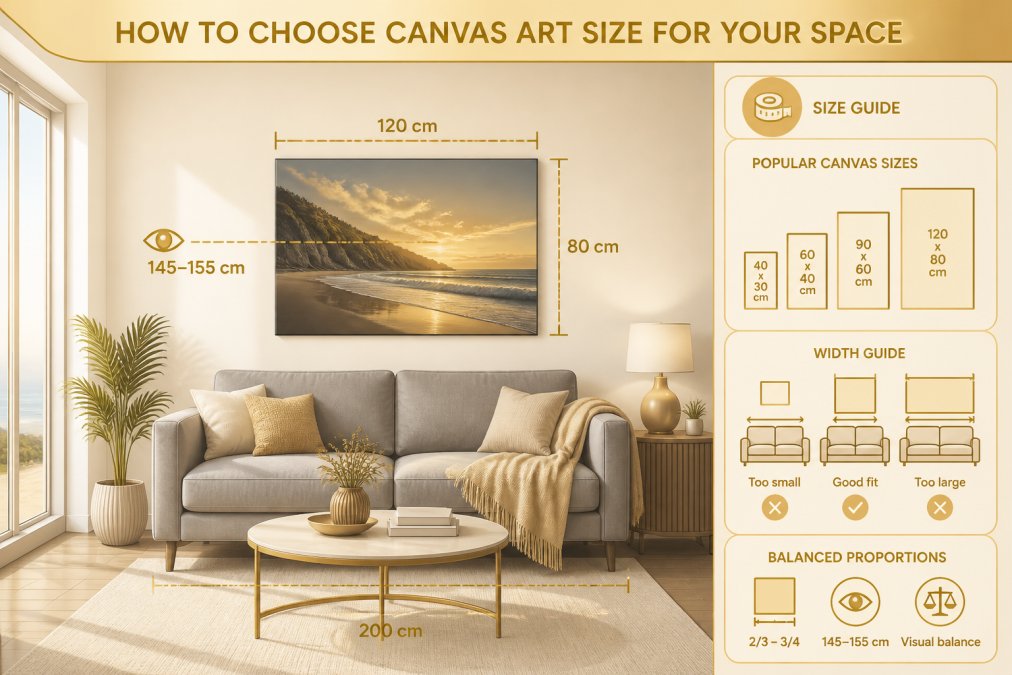
Your canvas should cover 50-75% of the wall space above a piece of furniture. For a standard 1.8-metre-wide sofa, a canvas between 1.1 and 1.4 metres wide creates visual balance. Viewing distance also matters: if viewing from across a large room, a smaller print gets lost; if viewing from 1 metre away, oversizing feels cramped.
Aspect ratio and room layout
Landscape-oriented prints suit horizontal wall spaces and open-plan rooms. Portrait-oriented prints work in narrow alcoves or above tall furniture. Square prints feel balanced and contemporary but work best in symmetrical arrangements. For coastal and landscape photography, landscape orientation usually works best because these images are composed to emphasise horizontal lines.
Gallery Wrap Versus Framed Canvas: Which is Right for You
Gallery wrap wraps the image around wooden stretcher bars, creating a floating-frame effect with no additional framing needed. It's the modern, minimalist choice and suits contemporary décor. Advantages: clean aesthetic, easier installation, takes up less wall depth. Disadvantage: if the canvas shifts, the entire piece looks compromised.
Framed canvas mounts the canvas onto a backing board inside a wooden or metal frame. It provides structural support and adds a finished, traditional look. Advantages: extra support, traditional aesthetic, hides canvas imperfections. Disadvantage: heavier, more difficult to hang, costs more.
For renters or anyone hesitant about wall installation, gallery wrap is the clear winner. It's lightweight, hangs from a single hook, and leaves minimal wall damage if removed. paints2prints offers both options.
Price, Value, and What You're Actually Paying For
Canvas print pricing varies widely online. A £30 print typically uses thin 200-250 GSM poly-dominant canvas and dye-based inks. A £69-£89 print from paints2prints uses 350+ GSM poly-cotton canvas and archival pigment inks. That difference reflects actual material and labour costs, not just branding.

Consider total cost of ownership. A £40 canvas that fades within 3 years costs £13 annually. An £80 canvas lasting 10+ years costs £8 annually. The expensive option is cheaper over time. When comparing prices, ask: What's the canvas GSM? What ink type? What's the warranty? Retailers confident in their product answer immediately.
Choosing high quality canvas art online requires balancing aesthetics with technical specifications. Canvas weight, ink chemistry, and printing resolution determine whether your art looks fresh in five years or faded in eighteen months. Before you buy, verify the material specs, confirm the DPI, and ensure the retailer stands behind their product. paints2prints offers poly-cotton canvas with archival inks and transparent specifications across their coastal and landscape collection, with free shipping to the UK and EU. Start with a piece like the Breaking Wave Ocean Wave Canvas Print, it delivers gallery-quality materials at a fair price, and you can customise the size to match your space exactly.
Frequently Asked Questions
How can I tell if a canvas print is high quality before buying?
Look for archival-grade materials, UV-resistant inks, and a poly-cotton blend canvas that resists warping and cracking. Check product descriptions for GSM (grams per square metre) weight, DPI resolution (minimum 150-300 DPI for clarity), and finish options like matte or satin. Examine customer photos showing the print in real homes, not just marketing shots. Reputable sellers like paints2prints provide detailed specifications and free shipping, reducing the risk of purchasing inferior artwork.
What should I look for when buying custom canvas prints?
When ordering custom canvas prints, ensure your digital file meets the seller's DPI and format requirements to avoid pixelation. Verify colour accuracy by checking if the seller offers colour-matched proofs or references. Confirm the canvas material (cotton-rich blends are more durable), stretcher bar quality, and edge wrapping method. Ask whether the print includes a protective coating against dust and UV damage. Confirm sizing options and whether you can adjust dimensions to fit your wall space precisely before finalising your order.
How do I choose the right size canvas for my wall?
Measure your wall space and aim for the artwork to cover about 50-75% of the wall area for visual balance. Consider the room's layout and viewing distance; larger prints work well in open living spaces, while smaller pieces suit narrow hallways or bedrooms. Check the aspect ratio to ensure it matches your wall dimensions. For coastal or landscape themes, wider formats often work better. Many retailers, including paints2prints, offer customisable sizing so you can select dimensions that fit your exact requirements before purchasing.
What's the difference between gallery-wrapped and framed canvas?
Gallery-wrapped canvas wraps the image around thick stretcher bars (typically 2-5 cm deep), creating a contemporary, borderless look that hangs directly on the wall. Framed canvas includes a traditional frame around the edges, adding weight and requiring more wall space but offering a classic aesthetic. Gallery wrap is ideal for renters and those wanting a modern appearance, while framing suits traditional interiors. Gallery wrap typically costs less and is easier to hang; framed options provide extra protection and a finished look. paints2prints offers both options to suit your style and budget.
This article was written using GrandRanker
0 comments